But his delight is in the law of the LORD, And in His law he meditates day and night. (Psalms 1:2)
Saturday, March 14, 2015
Exodus 10-12
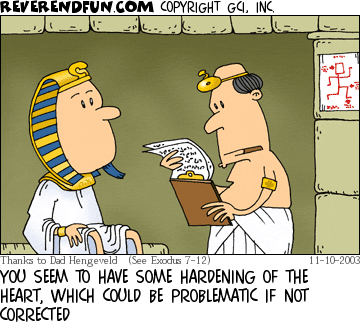
Exodus 10 to 12 records of the last three plagues of the ten plagues that fell upon Egypt because Pharaoh hardened his heart and refused to let the people of God go. As we read about the locusts infesting the entire land and devouring whatever food that is left after the hail, to the total darkness that lasted for three days such that it can be "felt", to the final deal of the death of all the first-borns in Egypt, we really see the power and authority of God over nature and life here. He is indeed the Lord of all creations. He made the locusts come so easily, and He also made them all go away so easily such that "not a single locust was left". It's really amazing for someone like me who fear insects so much!
We also see that God indeed look after His people and like what Bible Reader has mentioned in the previous post, that the people of God are clearly separated (consecrated) from the Egyptians. Although the whole of Egypt experienced terrible total darkness for three days, the Israelites on the other hand had light. It's amazing, isn't it? Imagine being one of the Israelites then watching these things unfold right before your eyes and experiencing the hand (and grace) of God directly!
The climax of the entire episode probably came during the Passover. This is the first time the people was commanded about the Passover, the first time they were told about the significance of it, what it entails actually. They were told that they were to sacrifice a lamb, to eat it within the house and they shall take the blood and put it on the two doorposts and on the lintel of the house. Otherwise, the destroyer might pass by and claim the life of the first-born within the house! There were also specific instructions on how to prepare the lamb and the manner in which they were to eat it. “You shall eat it in haste. It is the LORD’s Passover.” It suggests to me the urgency and tension in the air. That night must have been quite a dreadful night. Perhaps some were fearful or worried; perhaps some others were hopeful - God had said that after this, Pharaoh will let them go. However, it is quite sad that Egypt had to experience all ten plagues before Pharaoh relented.
The takeaway for me today is this: As the children of God, He will surely protect us. He will take care of us and provide for us. He will deliver us and save us! However, how often have we hardened our hearts towards God (perhaps even without knowing)? How long do we want to continue to harden our hearts towards God? It took Pharaoh ten plagues and the death of his firstborn before he relented. When a stone is thrown at us, it might be a nudge from God, prompting us to turn back to Him; don’t wait until a brick is thrown in our direction before we would finally repent!
Songs 1
Out of Solomon’s 1,005 song compositions, Songs of Songs is the only surviving poem, and the most outstanding of all (TJC e-Library). It not only describes the love between a husband and his wife, but most importantly it describes the kind of relationship that believers ought to have with the Lord Jesus. What kind of relationship do we have with our Lord Jesus today?
Is it like a business transaction - Jesus does something for me, and I will do something for Him?
Is it like a boss-worker relationship - He commands, while I do?
Is it like a Facebook follower relationship - oh yeah I ‘liked’ Him and once in a while I get updates from Him and occasionally I read what He posts?
Or is it like one in a deep loving relationship, constantly desiring to see Him, to touch Him, to talk to Him?
While the Bible in general describes our relationship with Jesus in many ways (e.g. Master and servant, Father and child), Songs of Solomon focused specifically on one aspect of our relationship with Jesus - we are the Bride and He is the Groom. Like most newly-weds, we ought to be desiring more and more of Jesus.
I remember when I first came to church, the words from the Bible were like honey to me. It was like I have never heard such beautiful words before! Especially after receiving the Holy Spirit, I find it a real joy to simply listen to His words of teachings and also to share it with others. Attending church was exciting because I never know how God might speak to me today, whether it was through the sermon, or through other brethren. I just wanted more and more of Jesus!
Today, perhaps after being in church for a while, the initial passion seems to die off.... and what’s left is a familial feeling. It is not that we do not love God - we do, but minus that initial passion. We are now... family.
Will this do?
Nevertheless I have this against you, that you have left your first love. (Revelation 2:4)
The Church of Ephesus did not seem like such a bad church – they had works, they had patience, they cannot bear those who are evil, they have laboured for Jesus and have not become weary. What is wrong then? What are the “first works” that they are called to repent and do again? What is this first love? Is it that passion and zeal that we initially have towards Jesus?
Hence, the Songs of Solomon is a reminder to us (including myself) about that first love. The time when we desired to be so close to Him. The time when we deemed His love as better than anything else, even the finest things of the world.
Let him kiss me with the kisses of his mouth—
For your love is better than wine. (Songs 1:2)
Let us go back to our first love and be drawn closer to Christ.
p.s. hymn 235 in Chinese is a touching hymn that depicts the love between the Church and Jesus. https://www.youtube.com/watch?v=XAD3zivHKfM
Wednesday, December 10, 2014
Joshua 16
"But of the cities of these peoples which the Lord your God gives you as an inheritance, you shall let nothing that breathes remain alive, but you shall utterly destroy them: the Hittite and the Amorite and the Canaanite and the Perizzite and the Hivite and the Jebusite, just as the Lord your God has commanded you, lest they teach you to do according to all their abominations which they have done for their gods, and you sin against the Lord your God. (Deuteronomy 20:16-18)
And they did not drive out the Canaanites who dwelt in Gezer; but the Canaanites dwell among the Ephraimites to this day and have become forced laborers. (Joshua 16:10)
The Israelites have forgotten about God’s
commandments! Even when these instructions are direct and non-ambiguous, these
people quickly forgot about them. It could also be worse: perhaps the
Israelites have ignored or dismissed them?
We might then question or even rebuke them
in our hearts saying, how is it that they dare to ignore God’s commandments as
though His words are nothing important! Why did they do that?
But isn’t it the same with us today?
Perhaps we do not mean it as an outright
challenge against God’s word. We definitely still believe in God and want to
follow Him. However at times, have we not also allowed certain small sins into
our life, thinking that it is okay, we
are in control, we know what the Bible says, but hey we know what we are doing
and we would not allow ourselves to cross the boundary okay?
The Ephraimites in today’s sharing probably
also felt the same. They have conquered the land and perhaps they felt superior
to the Canaanites. The Canaanites became forced labourers and perhaps the
Ephraimites felt that they have control over them, no problem at all. What can these Canaanites forced labourers do to us?
Some of them might even say, yeah! We
have God on our side!
Probably, the Ephraimites also saw the
benefits of keeping these Canaanites as forced labourers and hence decided to
keep them.
Similarly, we also often weigh the costs
and benefits of things before we decide whether to go ahead with it or not.
Even when the instructions are clear in the Bible, we leave some leeway for ourselves. Wow, this seminar is once-in-a-lifetime and
it can greatly help me in my professional development! But hey, it is on a Sabbath
Saturday.... it should be okay just to go this once?
The commandments of God are very clear: let
nothing that breathes remain alive. God knows what a little sin or a little
leeway can do to us. Leave the devil a foothold and he will grab your feet!
Every choice we make comes with a
consequence. In the case of today’s sharing, the consequence was spelt out in
Deuteronomy 20:16-18 and we see it in the later part of the history of Israel
when they continually sin against God by being led astray to worship false
gods. We cannot ignore the influence of “little sins”. We should not be haughty
to think that we have control over them and thus allow them to dwell within us.
A little drop of ink will taint the entire glass of water.
Let us strive to keep our glass of water
clear. Let us learn to drive out the Canaanites within us. For the God we
worship is a holy and perfect God. And He calls us to be holy and perfect as
well. J
Wednesday, November 19, 2014
Joshua 2
Most of us are relatively familiar with the story of Rahab.
This is the story of a harlot girl who later found herself
in the genealogy of our Lord Jesus (Matt 1:5). Her story was one about true
faith and acting upon it - to the extent of betraying her own country and
risking the death sentence. Her story was also one about the amazing grace of
God – how God’s abundant blessings could come upon a sinner, allowing her to
leave her world of sins behind and enter into the household of God.
Other than in the Book of Joshua, there are two other
mentions of Rahab in the Bible.
By faith the harlot
Rahab did not perish with those who did not believe, when she had received the
spies with peace. (Hebrews 11:31)
Likewise, was not
Rahab the harlot also justified by works when she received the messengers and
sent them out another way? (James 2:25)
Rahab was placed on the list of those who have triumphed by
faith in Hebrews 11, the only woman besides Sarah. She showed us an example of faith by which we
should learn from. Because she had faith in the God of Israel, she received the
spies. Because of her faith in God, she pleaded to be saved. Faith is not
merely a confession by mouth, saying, “I believe”, but entails acts of faith that
will speak louder about what you really believe in. Few might be as courageous
as Rahab, hiding the spies and risking her life. She must have really believed
in the true God to be able to do that!
Rahab was also the perfect example of one who trusted and
obeyed God. Every game has its own rules and the participants have to keep to
them. Even though Rahab really did have faith in God, had she not keep to the
“rules” of the agreement (not to tell others about the spies, tie a scarlet
cord by the window, have everyone stay within the house), she will also not be
saved.
The boundary that God has set is meant to save us, not to
make our lives miserable. One who does not wish to be restricted within the
house can choose to leave the house and face the eventual utter destruction by
the Israelite army. Similarly today, do we keep to the “rules” in the Bible
regarding salvation? Are we able to trust and obey?
Lastly, her concern for the safety and salvation of her loved ones was admirable. While pleading to be saved from the impeding calamity, she did not forget about her loved ones but included them. Likewise, as we have received the good news of salvation today, let us remember to share this with the people around us!
Wednesday, August 6, 2014
Proverbs 5
Today’s chapter warns us about the adulterous woman, whose lips drip honey and whose mouth is smoother than oil (Proverbs 5:3).
If we are not careful, she indeed seems very attractive and enticing. In Proverbs 9:17, she continues to seduce us by suggesting that
“Stolen water is sweet,
And bread eaten in secret is pleasant.”
The adulterous woman personifies the way of folly, and indeed to the foolish and him who lacks understanding (Proverbs 9:16), sinning appears to be exciting.
I have spread my bed with tapestry,
Colored coverings of Egyptian linen.
I have perfumed my bed
With myrrh, aloes, and cinnamon. (Proverbs 7:16-17)
The adulterous woman appeals to our sensual desires; Pleasure for the moment is emphasized with no consideration for any long term consequences.
This is the method of Satan, and the way our world is like right now.
In fact, even for those who “go straight on their way”, she is also constantly calling out to them (Proverbs 9:15). No one is spared. Seduction and temptations are all around us. But which way do we choose?
Proverbs teaches us the consequences:
But in the end she is bitter as wormwood,
Sharp as a two-edged sword.
Her feet go down to death,
Her steps lay hold of hell. (Proverbs 5:4-5)
Lest you give your honor to others,
And your years to the cruel one;
Lest aliens be filled with your wealth,
And your labors go to the house of a foreigner;
And you mourn at last,
When your flesh and your body are consumed,
And say:
“How I have hated instruction,
And my heart despised correction! (Proverbs 5:9-12)
And guides us on what to do:
Therefore hear me now, my children,
And do not depart from the words of my mouth. (Proverbs 5:7)
Remove your way far from her,
And do not go near the door of her house (Proverbs 5:8)
Drink water from your own cistern,
And running water from your own well. (Proverbs 5:15)
The adulterous woman and the wise woman in the Book of Proverbs personify the two ways of life – the way of the wisdom and the way of the folly. It is not only talking about a way of lifestyle we are choosing to lead our lives, but a matter of life and death here. Satan is leading with him onto the path of destruction those who choose not to follow on the way of wisdom.
While today’s chapter may specifically talk about sexual purity in marriage and about adultery, the foolish woman also symbolises any other sins that may be alluring us. The advice of drinking from your own cistern, while it teaches us to be faithful to one’s spouse, also teaches us about contentment and boundaries.
There are certain boundaries we cannot cross; but rather than toeing the line, let us find wisdom and strength to remove our way far from it instead.
The fear of the Lord is the beginning of wisdom,
And the knowledge of the Holy One is understanding. (Proverbs 9:10)
It seems apt to end with a hymn from our hymnbook (470):
There’s a line that is drawn by rejecting our Lord,
Where the call of His Spirit is lost,
And you hurry along with the pleasure-mad throng –
Have you counted, have you counted the cost?
You may barter your hope of eternity’s morn,
For a moment of joy at the most,
For the glitter of sin and the things it will win -
Have you counted, have you counted the cost?
While the door of His mercy is open to you,
Ere the depth of His love you exhaust,
Won’t you come and be healed, won’t you whisper, I yield -
I have counted, I have counted the cost?
Have you counted the cost, if your soul should be lost,
Though you gain the whole world for your own?
Even now it may be that the line you have crossed,
Have you counted, have you counted the cost?
Wednesday, July 23, 2014
Habakkuk 2
The book of Habakkuk is a really
interesting book; it documents the dialogue between God and the prophet Habakkuk
while he was trying to make sense of what was going on around him, and trying to
reconcile it with his faith.
Habakkuk’s first question to God
was – Why is God not doing anything about the evil in Judah? Why are the evil
people not punished?
Then, God told him that He is
sending the Babylonians to conquer Judah and bring judgment on Judah (Habakkuk
1:5-11).
To which, Habakkuk raised another
question – How could God use a nation that is even more wicked to chastise His
own people?
---
We all have our fair share of
moments like this, when we cannot seem to understand what God is doing, or if
He is even doing anything. Why do the
wicked seem to prosper, while those who are determined to follow Christ have to
suffer poverty, sickness, or tribulations?
When what we are experiencing
does not seem to tally with what we understand of God or what we understand
from the Bible, what do we do?
Habakkuk set a really good
example for us to follow.
Firstly, Habakkuk brought all his
questions before God. When we meet with a seemingly unjust situation, do we
first bring it before God, or men? When something happened that is beyond our
understanding, we should not be so quick to discount our faith, but to seek to
understand it more through prayers.
But as for me, my feet had almost stumbled;
My steps had nearly slipped.
For I was envious of the boastful,
When I saw the prosperity of the wicked.
... When I thought how to understand this,
It was too painful for me—
Until I went into the sanctuary of God;
Then I understood their end. (Psalm 73:2-3, 16-17)
My steps had nearly slipped.
For I was envious of the boastful,
When I saw the prosperity of the wicked.
... When I thought how to understand this,
It was too painful for me—
Until I went into the sanctuary of God;
Then I understood their end. (Psalm 73:2-3, 16-17)
Secondly, Habakkuk waited for
God. He went up to the watchtower to wait for God’s answers. As we present our
questions before God, we need to wait and also be sensitive to His promptings.
They may also come in the form of a verse in your daily bible reading, or
perhaps through a conversation with a brethren.
I will stand my watch
And set myself on the rampart,
And watch to see what He will say to me,
And what I will answer when I am corrected. (Habakkuk 2:1)
And set myself on the rampart,
And watch to see what He will say to me,
And what I will answer when I am corrected. (Habakkuk 2:1)
Finally, although Habakkuk did
not really understand why God was using the Babylonians to judge Judah, he did
not present himself as knowing more than God. He questioned God; but remained
humble to seek correction from God. From this, we know that although Habakkuk
may not fully comprehend what God was doing, he continued to have faith in
God’s goodness and know that His ways are higher than our ways, and His
thoughts are higher than our thoughts (Isaiah 55:9).
Similarly, we may have many
questions for God today, but we do so not in haughtiness, as though we know
better than God; but we do so to seek understanding, to know more and more
about Jesus.
In Habakkuk 2, we thus see God
explaining that in time to come, the Babylonians will too face judgment for
their iniquities. Hence, God is in control, He knows what He is doing, we need
not fear.
“But the LORD is in His holy temple.
Let all the earth keep silence before Him.” (Habakkuk 2:20)
This last verse reminded me of
one of my favourite verse (and hymn!) - Be
still, and know that I am God (Psalm 46:10a). No matter what we
may be facing at the moment, let us trust in our unchanging, Almighty God and
His goodness, and hence, be able to be still and wait on the Lord. Shalom.
Wednesday, July 9, 2014
Micah 2
Prattle.
Interesting word that the NKJV Bible use to translate Micah
2:6.
Prattle. Chatter. Babble. Ramble. Rattle on and
on.
These are synonyms.
But these are probably not words we would use to describe
the Word of God.
The original word in Hebrew is × ָטַ×£ nataph;
which means to drop, or to drip.
Drip, drip, drip.
Didn’t the Bible say that the Word of God is like the
drippings of the honeycomb?
They are more desirable than gold, yes, than much fine gold;
Sweeter also than honey and the drippings of the honeycomb. (Psalm 19:10, NASB)
To some, the word of God is like the drippings of the
honeycomb.
Sweet on our tongues, and enters into our hearts;
We just cannot help but rejoice!
Yet, perhaps to others, these drip-drops are like prattle.
Like mere babbling, or rambling.
Drip, drip, drip, drip ...
Soon, you become annoyed, irritated ... you wish it will
stop dripping!
For the time will come when they will not endure sound doctrine, but
according to their own desires, because they
have itching ears, they will heap up for themselves teachers; and they will
turn their ears away
from the truth, and be turned aside to fables. (2 Tim 4:3-4)
What kind of drip-drop nataph
are we?
And don’t forget,
“Behold, the days are coming,” says the Lord GOD,
“That I will send a famine on the land,
Not a famine of bread,
Nor a thirst for water,
But of hearing the words of the LORD.
“That I will send a famine on the land,
Not a famine of bread,
Nor a thirst for water,
But of hearing the words of the LORD.
They shall wander from sea to sea,
And from north to east;
They shall run to and fro, seeking the word of the LORD,
But shall not find it.
And from north to east;
They shall run to and fro, seeking the word of the LORD,
But shall not find it.
“In that day the fair virgins
And strong young men
Shall faint from thirst. (Amos 8:11-13)
And strong young men
Shall faint from thirst. (Amos 8:11-13)
While it is still dripping, eat it!
---
We should first examine our hearts and our attitudes towards
the Word of God. Have we really esteemed the Word of God or have we treated it
as something common, or worse, mere babble?
Then let us seize every opportunity to immerse ourselves in
the Word of God and allow the Word to cleanse us and change us.
You who are named
the house of Jacob:
“Is the Spirit of the LORD restricted?
Are these His doings?
Do not My words do good
To him who walks uprightly? (Micah 2:7)
“Is the Spirit of the LORD restricted?
Are these His doings?
Do not My words do good
To him who walks uprightly? (Micah 2:7)
May all of us find honey in His Word today J
Tuesday, June 24, 2014
John 17
Jesus prayed earnestly for His disciples before He was led
away, betrayed. Before the sinless had to die for the sinful, Jesus actually
prayed for us.
“I do not pray
for these alone, but also for those who will believe in Me through their word; (John
17:20)
Among the many teachings in this chapter, two related themes
stood out for me,
i)
Jesus and the Father are one.
ii)
We, as disciples of Christ, also ought to be
one.
For many of us, the first point may not be difficult to
understand. God is spirit; and we have understood from the Bible that Jesus
Christ is God coming in the flesh to fulfil the work of salvation on the cross.
He went about His Father’s business, and at this point in time when He made the
prayer, the work is about to finish...
What really strikes me, though, was the number of times
Jesus prayed for His disciples to be one, just as the Father and Son are one.
“Now I am no longer in the world, but
these are in the world, and I come to You. Holy Father, keep through Your name
those whom You have given Me, that they may
be one as We are.” (John 17:11)
“that they all may be one, as You, Father, are in
Me, and I in You; that they also may
be one in Us, that the world may believe that You sent Me. And the glory
which You gave Me I have given them, that they may be one just as We are one: I in them, and You in Me; that they may be made perfect in one, and that
the world may know that You have sent Me, and have loved them as You have loved
Me.” (John 17:21-23)
God desires that the Body of Christ (i.e. the Church) be
one. And the oneness is just like how Jesus Christ and God are one.
As I thought about the imperfections of the church as we see
it today... I cannot help but grew discouraged, wondering: What is this
oneness? What is this unity? How can we profess that we are one when we aren’t
even talking to each other?
However, my husband gave a reply that contained the simple
truth: “As long as the believers know the only true God, and Jesus Christ whom
was sent...” (John 17:3)
Indeed, as long as believers continue to hold fast the Word
of God,
“Sanctify them by Your truth. Your word is truth.“ (John 17:17)
and allow the Holy
Spirit to work in us,
“But the Helper, the
Holy Spirit, whom the Father will send in My name, He will teach you all
things, and bring to your remembrance all things that I said to you. (John
14:26)
we will be kept as One.
till we all come to
the unity of the faith and of the knowledge of the Son of God, to a perfect
man, to the measure of the stature of the fullness of Christ; (Eph 4:13)
Sunday, June 8, 2014
John 2
Jesus entered into the temple and drove away all those who
sold oxen and sheep and doves, as well as the money changers doing business in
the temple. He must have made quite a mess, pouring out the changers’ money and
overturning tables, and exclaiming, “Take these things away! Do not make My
Father’s house a house of merchandise!” (John 2:16)
The temple of God ought to be a holy place. It is a place of
worship to God. However, if we allow secular activities to have their place
within the temple, not only do we find it difficult to worship God
wholeheartedly, it is also disrespectful to God.
The Bible tells us that our body is the temple of God,
having the Spirit of God dwelling in us (1 Cor 3:16) and this record of Jesus
cleansing the temple reminded me about us cleansing our own temple of God.
Have we kept our temple free from oxen, sheep, and doves
that are sold in the marketplace? Have we kept the money changers away? These
things may mean different things to different people. Whatever it may be, when we
start to find our temple messy, we need to make the effort to cleanse it. Throw
away the things that should not be there. Organise the things that should
remain. Sometimes, we may even need to use a whip to drive out unwelcomed
guests. It may be painful, but it will be worth it. What you will get in the
end is a nice and clean temple. It is a place where the Holy Spirit will be
pleased to dwell in.
But your iniquities
have separated you from your God; And your sins have hidden His face from you,
so that He will not hear (Isaiah 59:2)
Let us cleanse our hearts before God, so that He may enter
in. Just as In Hymn 360, while we have room for pleasure and room for business,
do we also have any room for Jesus?
Wednesday, May 14, 2014
2 Kings 18
Hezekiah was a good king. His relatively long reign of twenty-nine years was testimony of God’s blessing as he did what was right in the sight of the Lord (2 Kings 18:2-3).
He removed the high places, forbidding people to worship at places other than where God has instructed. He broke the bronze serpent made by Moses more than 800 years ago to deliver the people from a plague of fiery serpents (Numbers 21:1-9), but which had became an idol of worship.
The Bible described Hezekiah as one holding fast to the Lord and did not depart from following Him, but kept His commandments. God was with Him, and he prospered wherever he went; he rebelled against Assyria and subdued the Philistines.
During Hezekiah’s reign, he also saw for himself how Israel fell captive to Assyria because they did not obey the voice of the Lord. This perhaps was significant for him and all the rest in Judah, both as a warning of the consequences of sins and as an affirmation of their faith.
However, the time came for his faith to be tested. The fortified cities of Judah were taken by Assyria. What would King Hezekiah do now? We saw that he tried to appease Assyria by giving the king of Assyria silver and gold. However, that did not stop the king of Assyria who later sent his men to taunt Hezekiah. He was mocked for putting his hope in an alliance with Egypt, and his faith in God was discouraged.
Perhaps this may reflect our life of faith in Jesus today? We are good Christians who readily obey the commandments of God. We keep the Sabbath. We pray. We follow the Lord. We might even have seen how some others have fallen away from the faith and the consequences that follow. We saw it as a warning to ourselves and also a resolution never to follow in their footsteps. However, the test really only comes when we are faced with the same situation. What would we do now? Would we still rely on God or rely on our own wisdom? Will we give up on God and seek help in worldly strength?
What did Hezekiah do (2 Kings 19)? J
that the genuineness of your faith, being much more precious than gold that perishes, though it is tested by fire, may be found to praise, honor, and glory at the revelation of Jesus Christ (1 Peter 1:7)
Have you met with any trials which really tested your faith? How did you pass the test?
Thursday, February 13, 2014
2 Samuel 1
Saul is dead.
The story of Israel’s first earthly king ends here, rather
tragically. In the battle with the Philistines, Israel has lost terribly.
Saul’s sons were killed, including Jonathan, the beloved friend of David.
In the previous chapter, we read that Saul has fallen on his
own sword, after his armorbearer would not agree to kill him. He was already very
badly wounded by the archers and at that moment, he decided that he would
rather kill himself than to be killed by the Philistines.
However, in today’s reading, apparently, an Amalekite came
to David and reported that he had been the one who killed Saul, bringing even
the king’s crown and bracelet to offer to David. It seemed as though he had
deliberately done so to gain favour with David, the next king, and David was
aware of it,
“when someone told me,
saying, ‘Look, Saul is dead,’ thinking to have brought good news, I arrested
him and had him executed in Ziklag— the one who thought I would give him a reward for his news." (2 Samuel 4:10)
I am not absolutely sure whether his report is true or
whether he is lying just to get a reward. I am equally unsure whether David
knows if he is lying or whether he believed what was reported. However, based
on the Amalekite’s own testimony (2 Samuel 1:16), David executed him.
God’s anointed – He
will personally deal with him
On several occasions, David kept himself from doing harm to
Saul, for he recognised that Saul was God’s anointed.
And he said to his
men, “The Lord forbid that I should do this thing to my master,
the Lord’s anointed, to stretch out my hand against him, seeing
he is the anointed of the Lord.” (1 Samuel 24:6)
And in today’s story, a harsh punishment was given to the
Amalekite who claimed to have killed the Lord’s anointed.
There are two reasons why we should not take it into our own
hand to harm/”punish” the Lord’s anointed as can be seen in the verse below:
But David said to
Abishai, “Do not destroy him; for who can stretch out his hand against
the Lord’s anointed, and be guiltless?” David said furthermore,
“As the Lord lives, the Lord shall strike him, or his day
shall come to die, or he shall go out to battle and perish. (1 Samuel
26:9-10)
Firstly, we are not without guilt when we harm/kill someone,
even if we deemed it as executing justice. We usually like to take matters into
our own hand, and we like to think of it as fulfilling God’s will and God’s
righteousness. However, vengeance is the Lord’s and it takes trust and patience
on our side to hold on to that. Today, we may not physically harm someone, but
how about our speech and indirect actions?
Secondly, God will definitely deal with His anointed,
especially when he has gone down the wrong path. Surely, God is watching and He
knows; we need to wait on the Lord and trust in Him.
Today, we are all God’s anointed (2 Cor 1:20-22). Having
this special status means the protection of God, but it also means that we are accountable
to God for all our deeds.
David’s excellent
character
I would like to end off with a note on David’s excellent
character regarding the death of Saul, his long-time enemy. Any normal man of
flesh and blood would have at least heave a sigh of relief, or be secretly happy
about his death. However, I believe that David was genuine in his grief and
mourning.
I initially thought that David was mourning for Israel’s
defeat more than grieving over the death of Saul and Jonathan. However, in his lamentation, David was
sincere in mourning over the loss of Saul and Jonathan, calling them “beloved”
and “mighty”. How much of our enemy’s positive traits can we see?
May we learn from David not to take it into our own hands to
do harm to someone who had done wrong to us, but to trust in the Lord’s
deliverance. Let us learn from David’s excellent character, not to dwell on the
person’s shortcomings and sins, but to let go of past hatred and hurt.
Monday, January 27, 2014
1 Samuel 19 - From resentment to murder
In today’s chapter, we see how Saul sought to kill David.
His resentment and jealousy towards David started with a song
“Saul has slain his
thousands,
And David his ten thousands.” (1 Samuel 18:7)
and have grown to such an extent that he cannot seem to hold
it back anymore. Although he was initially persuaded by Jonathan not to take
David’s life (1 Samuel 19:6), yet another victorious return by David against
the Philistines has once again triggered Saul’s jealousy (1 Samuel 19:9-).
To be honest, from a mental health professional’s point of
view, it almost seemed like Saul has “lost it”. His resentment and jealousy was
affecting him and he was portrayed as if he was constantly on guard against
David. In today’s chapter, he was so bent on getting David that he sent
messengers many times and even went to Ramah himself.
There was only one thing on his mind – to kill David.
In the Bible, there are other similar examples (e.g. Cain
and Abel, Joseph and his brothers) whereby horrible deeds were committed out of
jealousy or resentment. Abel was murdered. Joseph was sold to Egypt. And often
these acts of jealousy/resentment started with something harmless...
Abel was simply offering his best to God, while Joseph was
simply doted by his father.
The Bible exhorts us to put away all bitterness, wrath,
anger, clamor, and evil speaking (Ephesians 4:31). If we are not careful to
exterminate bitterness at the root, bitterness will grow, “spring up”, and
“cause trouble” (Hebrews 12:15). Before we know it, we are already murderers
(maybe not literally, but in our hearts (c.f. Matthew 5:21-22)).
If there is someone whom we have issues
with, or if we find ourselves starting to resent someone or to be jealous of
somebody, do not let these feelings grow in secret. The more we feed these
negative feelings, the more these feelings will grow, and before we know it,
they overwhelm us like how Saul was overwhelmed with his desire to kill David.
Let us confess our sins to someone we trust
so that there is accountability, and let us pray for each other and be healed
(James 5:16).
We cannot win the battle alone. We need
God, and we need a group of Godly people who will fight together with us. Have
you got your army of Godly people? J
Tuesday, January 14, 2014
1 Samuel 10
In today's reading, Samuel officially announced the word of God to Saul, and prophesied to him what is to happen so that he may obey. Saul was anointed and later proclaimed to the whole of Israel as King. Indeed, from today's chapter, it appeared that Saul, though initially overwhelmed (1 Sam 9:21), was submissive to the will of God.
Importantly, it was significant to me that Samuel told Saul that the Spirit of the Lord will come upon Saul and that he will be turned into another man (1 Sam 10:6). And indeed, the BIble records that God gave Saul another heart (1 Sam 10:9).
Then the Spirit of the Lord will come upon you, and you will... be turned into another man (1 Sam 10:6).
So it was, ...that God gave him another heart; and all those signs came to pass that day (1 Sam 10:9).
But we know that subsequently, Saul failed; he was not obedient to the word of God, and David took over him as king,
How is it possible that someone with the Spirit of the Lord can fail? Someone who has been turned into another man and given another heart by God?
Importantly, it was significant to me that Samuel told Saul that the Spirit of the Lord will come upon Saul and that he will be turned into another man (1 Sam 10:6). And indeed, the BIble records that God gave Saul another heart (1 Sam 10:9).
Then the Spirit of the Lord will come upon you, and you will... be turned into another man (1 Sam 10:6).
So it was, ...that God gave him another heart; and all those signs came to pass that day (1 Sam 10:9).
But we know that subsequently, Saul failed; he was not obedient to the word of God, and David took over him as king,
How is it possible that someone with the Spirit of the Lord can fail? Someone who has been turned into another man and given another heart by God?
We might even start to wonder if Saul was true in the first place.
Then, this verse came to my mind,
Therefore, if anyone is in Christ, he is a new
creation; old things have passed away; behold, all things have become new. (2
Corinthians 5:17)
Haven’t we also been made new by the precious blood of Jesus? When we
enter into the covenant with God, and receive water baptism, our sins are
washed away and we are reconciled with God. The old man has died, crucified to
the cross, and the new man now lives (cf Romans 6:4,6). Furthermore, the Spirit
of God is living in us when we receive the precious Holy Spirit as our Helper.
It’s true! We have become new creations, ....but it does not (and
cannot) stop there.
Therefore we do not lose heart. Even though our outward man is
perishing, yet the inward man
is being renewed day by day. (2 Corinthians
4:16, emphasis mine)
Apple of His eye talks about being spiritually renewed and how Saul was
not, thus leading to his failure. And in the verse above, the Bible says our
inward man is being renewed day by day.
We need to be constantly renewed.
God chose Saul. His spirit was upon him and He gave him a new heart. But
Saul eventually failed because he was not spiritually renewed day by day.
Similarly, God has chosen us; we have become new man in Christ, and have even
received His Holy Spirit. But are we renewed day by day?
... that you put off, concerning your former conduct, the old man which
grows corrupt according to the deceitful lusts, and be renewed in the spirit of your mind, and that you put on the new man which
was created according to God, in true righteousness and holiness. (Ephesians
4:22-24, emphasis mine)
And do not be conformed to this world, but be transformed by the renewing of your mind, that you may prove what is that good
and acceptable and perfect will of God. (Romans 12:2, emphasis mine)
Many of us may think that we have been baptised and we have received the
Holy Spirit, and that is sufficient. However, in this marathon of faith, we
need to keep up our faith. By the grace of God, we are all made new at the
starting point, and He has promised He will be with us. While this start is
important, only those who endure to the end will be saved. Let every day be a
day of renewal as we draw closer to Him day by day until the finishing line.
Wednesday, December 18, 2013
Hosea 8
In previous
chapters, we have read much about the rebuke of Israel’s unfaithfulness,
together with serious warnings about the consequences, and a sincere plea for
Israel’s repentance in order to restore their relationship with God.
“Set the trumpet to your mouth!
He shall come like an eagle against the house of the Lord,
Because they have transgressed My covenant
And rebelled against My law. (Hosea 8:1)
He shall come like an eagle against the house of the Lord,
Because they have transgressed My covenant
And rebelled against My law. (Hosea 8:1)
In today’s
chapter, the message continues, but appeared to have reached another level. The
chapter began with an instruction to “set the trumpet to [their] mouth,”
signifying the announcement of a major event. There seemed to be greater
urgency and finality here as the chapter starts with the prophecy of the
‘eagle’ against the house of the Lord, and ends with God’s concluding statement
that He will send fire upon the cities.
“For Israel has
forgotten his Maker,
And has built temples;
Judah also has multiplied fortified cities;
But I will send fire upon his cities,
And it shall devour his palaces.” (Hosea 8:14)
And has built temples;
Judah also has multiplied fortified cities;
But I will send fire upon his cities,
And it shall devour his palaces.” (Hosea 8:14)
Similar to
previous chapters, we read of the apostasy of Israel and how they have
committed spiritual harlotry. Yet, in today’s chapter, what is different is the
focus on the consequence. No mercy mentioned here. Neither is hope given. Scary
is such a day!
I have written for him
the great things of My law,
But they were considered a strange thing. (Hosea 8:12)
God has
clearly and repeatedly revealed Himself to Israel and His commandments are
clear. Yet Israel has time and again broken the covenant they had with God.
They have chosen the path without God, and although they still offered
sacrifices (going through the motions of their faith), their hearts were far
from God.
2 Timothy
3:5 speaks about men in the last days having a form of godliness but denying
its power. These people may appear to be godly but in fact, they do not have a
personal relationship with God! They do not know God (Hosea 4:1); neither would
God know them (Matthew 7:21-23)!
Today, the
trumpet has sounded; the second coming of the Lord is at hand. God has revealed
Himself clearly to us through the Bible but are we going through the motions of
our faith without really knowing Him? Let’s not wait until God announces, “This
is it! No more mercy. No more hope,” before we cry, “My God, we know You!”
(Hosea 8:2). Let everyday be a new beginning to know God at a deeper level.
Monday, November 25, 2013
1 John 3
Behold, what manner of love the Father has
given unto us!
Behold, what manner of love the Father has given unto us!
That, we should be called the sons of God J
Behold, what manner of love the Father has given unto us!
That, we should be called the sons of God J
A simple
beautiful melody that sings of the love of God and you can almost imagine
brethren joined hands going round and round…. Indeed, it is so amazing that God
would love us, despite our many flaws and imperfections, and how we have often
failed Him time and again.
But God demonstrates His own love toward us, in
that while we were still sinners, Christ died for us. (Romans 5:8)
It is even
more amazing that we are called His children when we have done nothing on our
part to deserve it. Yet, He loves us by laying down His life for us. And by His
sacrifice, we are reconciled with God.
… the love of God has been poured out in our hearts by the Holy
Spirit who was given to us. (Romans 5:5)
With this
love of God which has been richly poured out in our hearts, we ought to go
forth and pour this same love to those around us. One who has truly received
the love of God poured abundantly into his hearts will naturally pour out love
to those around him. Like an overflowing jug of wine or like the sweet aroma of
frankincense, you cannot contain it. It naturally flow and impact those around
us.
If you are
feeling (spiritually) dry, and seemed to find no love to give, perhaps it is a
good time to stop, take a breather, and try to immerse yourself once again in
God. God is love. How can we say that we are children of God if we find
ourselves with no love to give?
By this we know love, because He laid down His
life for us. And we also ought to lay down our lives for the
brethren. (1 John 3:16)
Love must
also not be in word or in tongue, but in deed and in truth. Love necessarily
entails sacrifice. Today, we may not literally die for one another, but we are
still called to ‘lay down our lives’ in other ways. What are some of the ways
we may ‘lay down our lives’ for others?
Monday, October 28, 2013
Jonah 3-4
Jonah heeded God’s command this second time and preached to the people of Nineveh. The people believed and they repented. They fasted, covered themselves with sackcloth, and sat in ashes – every one of them from the greatest to the least of them.
We know that they have indeed turned from their evil way and from the violence in their hands as we read of Jesus’ testimony of them in Matthew:
“… The men of Nineveh shall stand up with this generation in the judgment, and shall condemn it because they repented at the preaching of Jonah; …” (Matthew 12:41).
When one sinner repents, there is joy even in the presence of the angels in heaven (Luke 15:10). And yet we read here that Jonah was angry. Why so?
When someone we know turn back from his wrongdoings and repent before God, do we receive him back with open arms? This reminded me of the parable of the prodigal son when the brother started to grumble and murmur against the father who was showing exceptional grace towards him who had returned home.
Did Jonah not know that God was a gracious and merciful God, slow to anger and abundant in lovingkindness (Jonah 4:2)? He knows! It was precisely because he knows that he ran away from God the first time. He knew that God would surely relent if the people repented.
So, that could only mean that…. Jonah was not happy that God relented. He was angry that God had showered His grace upon the people of Nineveh. He did not think that they deserve such grace.
Similarly, today, it could be easy for this kind of attitude to seep unknowingly into our mindset, especially for us who have been in church for a long time.
Because we have put in much effort to work out our salvation with fear and trembling, to keep His Word and to be holy, it almost feels like we have earned the grace. We have forgotten that the definition of grace itself is something that cannot be earned, but is freely given.
None of us deserve the grace that God has given us. And there is no way we can earn this grace. So how can we exclude others from the grace of God?
Even the seemingly most undeserving man deserves a chance to repent. How can we play the Judge and condemn?
Therefore,
Let this mind be in you which was also in Christ Jesus… (Philippians 2:5)
As we continue our walk with God, may we grow to be more and more like Him. Let His heart which desires all men to be saved be also found in ours.
Tuesday, October 15, 2013
Lamentations 3
Have you ever had your world come crumbling down, and everything you had hoped for is gone; when all you see is darkness, and every step feels heavy as though your feet have been chained; when you tried to cry and shout, but no words came out; when you feel as though your heart’s been pierced, and you find yourself walking alone?
Prophet Jeremiah penned down his anguish in this chapter, seeing his prophecy becoming reality right before his very eyes. He was lamenting, grieving.
Grief is a very normal emotional process that we all will go through. We might grief over the loss of a job, a good opportunity, the death of a loved one, or some other things. Jeremiah grieved for Jerusalem, for Israel, seeing the state that it has become. Do we also grieve over the state of our (spiritual) life?
However, grief must be coupled with hope; otherwise we will find ourselves sinking deeper and deeper into that bottomless pit of depression.
In this same chapter, we read about the prophet’s hope in God.
This I recall to my mind,
Therefore I have hope.
Through the LORD’s mercies we are not consumed,
Because His compassions fail not.
They are new every morning;
Great is Your faithfulness.
“The LORD is my portion,” says my soul,
“Therefore I hope in Him!”
(Lamentations 3:21 - 24)
The prophet recalled to his mind the Lord’s mercies, therefore he has hope. The amazing thing about being Christians is our hope in God - we know that He will never forsake us, and that even if all else fails, we know that He will bring us back to our heavenly home at the end, and this brings assurance to us and gives us a living hope.
(However, food for thought - how do we recall to our minds the words and promises of God, during times of need, if we do not first read His Word daily?)
The LORD is good to those who wait for Him,
To the soul who seeks Him.
It is good that one should hope and wait quietly
For the salvation of the LORD.
It is good for a man to bear
The yoke in his youth.
Let him sit alone and keep silent,
Because God has laid it on him;
(Lamentations 3:25 - 28)
During these tough times, we must also learn to wait for Him, and to seek Him. In other words, we must constantly strive to be nearer and nearer to God. We seek not just for comfort, or peace, but we also seek a sort of understanding; we seek to understand God more and more.
“I have heard of You by the hearing of the ear,
But now my eye sees You. (Job 42:5)
And during these times, it is probably best to be quiet. Have our quiet time with God alone. Meditate on His Words. Pray. You may be amazed at the still, small voice that has been trying to reach you while you had been buzzing around.
For the Lord will not cast off forever.
Though He causes grief,
Yet He will show compassion
According to the multitude of His mercies. (Lamentations 3:31-32)
So while we remain in the rubbles and ruins and broken pieces (whether due to our wrongdoings, or as a trial from God), let us learn from Jeremiah to focus on God, and to hope in Him, while we seek Him and wait for Him in quietness.
Let us search out and examine our ways,
And turn back to the LORD;
Let us lift our hearts and hands
To God in heaven. (Lamentations 3:40-41)
Prophet Jeremiah penned down his anguish in this chapter, seeing his prophecy becoming reality right before his very eyes. He was lamenting, grieving.
Grief is a very normal emotional process that we all will go through. We might grief over the loss of a job, a good opportunity, the death of a loved one, or some other things. Jeremiah grieved for Jerusalem, for Israel, seeing the state that it has become. Do we also grieve over the state of our (spiritual) life?
However, grief must be coupled with hope; otherwise we will find ourselves sinking deeper and deeper into that bottomless pit of depression.
In this same chapter, we read about the prophet’s hope in God.
This I recall to my mind,
Therefore I have hope.
Through the LORD’s mercies we are not consumed,
Because His compassions fail not.
They are new every morning;
Great is Your faithfulness.
“The LORD is my portion,” says my soul,
“Therefore I hope in Him!”
(Lamentations 3:21 - 24)
The prophet recalled to his mind the Lord’s mercies, therefore he has hope. The amazing thing about being Christians is our hope in God - we know that He will never forsake us, and that even if all else fails, we know that He will bring us back to our heavenly home at the end, and this brings assurance to us and gives us a living hope.
(However, food for thought - how do we recall to our minds the words and promises of God, during times of need, if we do not first read His Word daily?)
The LORD is good to those who wait for Him,
To the soul who seeks Him.
It is good that one should hope and wait quietly
For the salvation of the LORD.
It is good for a man to bear
The yoke in his youth.
Let him sit alone and keep silent,
Because God has laid it on him;
(Lamentations 3:25 - 28)
During these tough times, we must also learn to wait for Him, and to seek Him. In other words, we must constantly strive to be nearer and nearer to God. We seek not just for comfort, or peace, but we also seek a sort of understanding; we seek to understand God more and more.
“I have heard of You by the hearing of the ear,
But now my eye sees You. (Job 42:5)
And during these times, it is probably best to be quiet. Have our quiet time with God alone. Meditate on His Words. Pray. You may be amazed at the still, small voice that has been trying to reach you while you had been buzzing around.
For the Lord will not cast off forever.
Though He causes grief,
Yet He will show compassion
According to the multitude of His mercies. (Lamentations 3:31-32)
So while we remain in the rubbles and ruins and broken pieces (whether due to our wrongdoings, or as a trial from God), let us learn from Jeremiah to focus on God, and to hope in Him, while we seek Him and wait for Him in quietness.
Let us search out and examine our ways,
And turn back to the LORD;
Let us lift our hearts and hands
To God in heaven. (Lamentations 3:40-41)
Wednesday, September 25, 2013
Colossians 1
Colossians 1 started with Paul commending the believers at Colosse Church for their faith, love, and hope, three of the most common categories used to describe our belief. Do you know of anyone who exhibits great faith, love, and hope?
Perhaps someone who has acted like a mentor to you in your life of faith or someone who has helped you in times of need before?
We give thanks to the God and Father of our Lord Jesus Christ, praying always for you, (Colossians 1:3)
When you think about that person, do you give thanks to God? Would you praise God for having kept that person in his faith? Would you count it as a blessing to have known such a person?
I thank my God upon every remembrance of you, always in every prayer of mine making request for you all with joy, (Philippians 1:3-4)
Paul indeed gave thanks to God for having known such brethren in Christ. In fact, he prayed for them since the day he heard of their faith, and always in every prayer of his.
What do we pray about in our prayers? Who do we pray for?
Even though these believers are already commendable for their faith in Christ Jesus, and for their love for the saints, Paul continued to emphasize that they never ceased praying for them. And the prayer request that follows pretty much also sums up for us what sort of spiritual nurture we should all aim towards:
“and to ask that you may be filled with the knowledge of His will in all wisdom and spiritual understanding; that you may walk worthy of the Lord, fully pleasing Him, being fruitful in every good work and increasing in the knowledge of God; strengthened with all might, according to His glorious power, for all patience and longsuffering with joy; giving thanks to the Father who has qualified us to be partakers of the inheritance of the saints in the light.” (Colossians 1:9-12)
Lately, I find my prayers being very self-focused, or only focused on the people who are closest to me. Many factors may have contributed to such “selfish” prayers but I remembered there was a time when it used to be easier making intercessory prayers, whether for a individual or for the church.
What happened? Have I grown weary of making intercessions? Or perhaps it got to do with the love we have for our brethren. When love starts to grow cold, we are rather contented just praying for our small group of loved ones.
However, let us not forget that intercessory prayers are powerful. The Bible encourages us to confess our sins to each other and to pray for each other.
Confess your trespasses to one another, and pray for one another, that you may be healed. (James 5:16)
Perhaps it is the love component in intercessory prayers that move God to heal us. Whatever it is, God is pleased whenever we come together as one.
If every one of us can always remember someone else in prayer, isn’t that a beautiful thing to God, because in God’s eyes, we are connected by prayers!
Let this hymn reminds us that, while someone is praying for us, let us also be that someone to be praying for somebody else :)
Someone is praying for you
So when it seems you’re all alone
And your heart will break in two
Remember someone is praying for you.
Have the clouds round you gathered in the midst of the storm
Is your ship tossed and battered
Are you weary and worn
Don’t lose hope someone’s praying for you this very day
And peace be still, He’s already on the way
When it seems that you prayed till your strength is all gone
And your tears fall like raindrops all the day long
He is there and He knows just how much you can bear
He’ll speak your name to someone in prayer
Give thanks for someone in your prayer today <3>3>
Monday, September 9, 2013
2 Corinthians 6
When life as a Christian starts to be easy for you, when you find yourself quite comfortable and enjoying your life, taking in the pleasures and delights of what you recognized as God’s blessings, when all seemed too good to be true, … it is good to stop, be still, and ponder about your relationship with God.
Yes, God is good. And His blessings are abundant upon those who truly seek after Him. He does shower us with material blessings. He also blesses us with loving family and friends.
However, when we start to see these blessings as more important than God Himself, we have to be wary. In fact, when these blessings overflow our cups, do we only see these blessings or can we still see beyond and see God?
The ministry of Paul and the other apostles then cannot be compared with our ministry today. Especially in affluent Singapore, we generally lead quite comfortable lives. It is definitely hard to understand the extent that Paul and the other apostles went for the sake of the gospel, but we know that they went all out so that their ministry “may not be blamed” or “so that no fault may be found with their (our) ministry”.
To go all out however requires us to move out of our comfort zones, as Paul described – in afflictions, beatings, sleepless nights, hunger, meeting with slander, treated as impostors, as sorrowful, etc. While we may not meet with these exact uncomfortable situations today, we may meet with a need to change our schedule for a friend so that we can have bible study together, or we may have to bear with colleagues’ talk behind our backs about why we do not celebrate Christmas.
These are uncomfortable situations, none of us like them; but do we still do it… because of Jesus?
To be honest, I still find it hard to find that “balance” – to what extent do I have to go to be considered as suffering for the Lord? Do I have to be praying in tears every day? Do I have to find myself going here and there preaching, pastoring, and finding myself all stressed up and tired in order to be called a servant of Christ?
What Paul went through was no easy feat, and I honestly do not know if I could have done the same if I were there at that time, but then perhaps I could, if I truly know how to rely on the Holy Spirit to lead me.
And I guess the day when we learn how “to be sorrowful, yet always rejoicing”, how “to be poor, yet making many rich”, how “to have nothing, yet possessing everything” is probably the day when we find that “balance”.
In the meantime, when life starts to get quite comfy, thank God for all those blessings, but also stop, and do a little reflection of your relationship with Christ, remembering that, sometimes, we need to be a little uncomfortable, in order to bring comforts to those who need it.
…. we appeal to you not to receive the grace of God in vain. (2 Corinthians 6:1)
Sunday, August 25, 2013
Jeremiah 39
Three
different characters
Three different outcomes
Dependent on the different choices they made
And the eventual action they took
Three different outcomes
Dependent on the different choices they made
And the eventual action they took
Zedekiah
made king
But he chose not to give heed
Neither did the people listen
To the words of God through Jeremiah
But he chose not to give heed
Neither did the people listen
To the words of God through Jeremiah
Zedekiah instructed
Jeremiah to pray for them
He secretly asked for the word from the Lord -
Once, twice.
But he has his fears
He chose to hold on to them
And chose not to heed the advice
He did not put his trust on God
He secretly asked for the word from the Lord -
Once, twice.
But he has his fears
He chose to hold on to them
And chose not to heed the advice
He did not put his trust on God
The
Chaldeans came
They took him captive
Gouged out his eyes
Set the city on fire
According to what the Lord had said,
it has happened
Because he has not heed the word he has heard
They took him captive
Gouged out his eyes
Set the city on fire
According to what the Lord had said,
it has happened
Because he has not heed the word he has heard
Ebed-Melech,
the Ethiopian enunch
He heard about Jeremiah’s plight
He knew Jeremiah as a prophet of God
He sought the king’s permission
He rescued the prophet
And he was not forgotten
He heard about Jeremiah’s plight
He knew Jeremiah as a prophet of God
He sought the king’s permission
He rescued the prophet
And he was not forgotten
The word of
the Lord came for him
The promise of the Lord
Of deliverance, and comfort,
For he has put his trust in Him
The promise of the Lord
Of deliverance, and comfort,
For he has put his trust in Him
Jeremiah,
the weeping prophet
Many times he has spoken
In tears he pleaded
So that the people might live
Many times he has spoken
In tears he pleaded
So that the people might live
Yet he was
thrown into prison
He was misunderstood
He was cast into the dungeon
He sank in the mire
He was misunderstood
He was cast into the dungeon
He sank in the mire
The
Chaldeans came and besieged the city
According to the words he has spoken
According to the words God has spoken through him
Jeremiah chose to speak God’s words
And eventually was freed from prison
According to the words he has spoken
According to the words God has spoken through him
Jeremiah chose to speak God’s words
And eventually was freed from prison
God remembers
His people
He delivers those who seek refuge in Him
The Lord of
hosts has sworn, saying,
“Surely, as I have thought, so it shall come to pass,
And as I have purposed, so it shall stand (Isaiah 14:24)
“Surely, as I have thought, so it shall come to pass,
And as I have purposed, so it shall stand (Isaiah 14:24)
Three
different stories
Depending on their faith in God and their trust in His words
Beyond the fear that lies in front of you,
Depending on their faith in God and their trust in His words
Beyond the fear that lies in front of you,
What would you choose?
What would be your story?
Subscribe to:
Posts (Atom)